
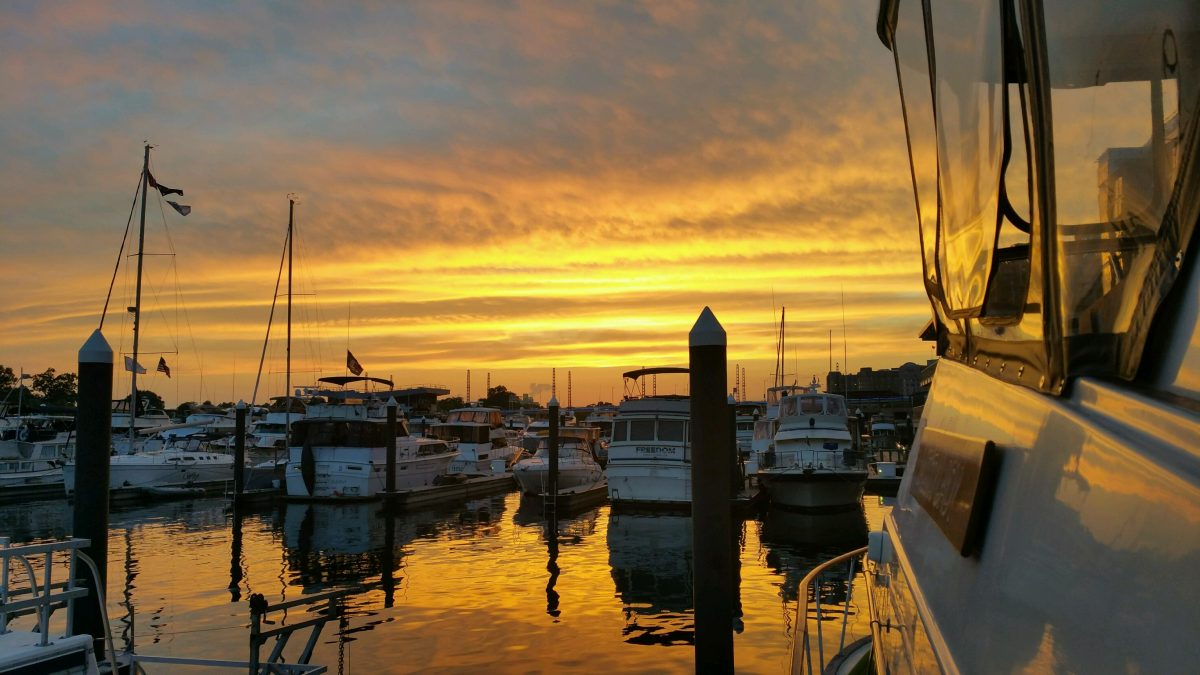
Let’s take a short step back and let me relate a particular incident aboard the Misty Lady. As you may recall, we obtain our slip assignments through a bidding process using our Member number as an indicator of our seniority, lowest number bidding on a particular slip, wins the day and has the home berth in that slip.
We had been awarded a 60 foot slip on the A dock and were settling into it as our home, when another opportunity to bid on a slip further out on the A dock. The further out one’s slip is, the better the view and the easier to depart and arrive at the marina section of the Capital Yacht Club. In this case, we won the compete for slip A-10, which would place us almost halfway up the dock area.
On the day we chose to make the move from our A4 slip to the A10 slip, we had assistance from one of the Club dock stewards to assist in our departure preparations. The gen set had been started and we switched from on shore power to on board generated power, and directed the steward to remove our power cord connection. We then began the process of untying our dock lines and Charlotte was at the bow deck to receive the lines as the steward removed them from the dock. I was on the bridge, and got the main engines started and warming. Charlotte called back to remind me to ensure that the rudders were in the straight ahead position. As I started to do that, the helm wheel spun like a top, no resistance indicating the hydraulic pressure was not there and the system was not working. WE HAD NO RUDDER CONTROL!
Our original intent was to take the Misty Lady out of the old slip, travel down the Channel to the Potomac and then down to the Wilson Bridge. We were then to return to the Club and move into the new A-10 slip. With the loss of helm control, there was no way I was going to take this big girl out into the river with all the other boats and not able to use the helm to steer out of the way of the boating idiots. You must have seen the type, they think nothing of driving across the bows of our big girl. We weigh 55 thousand pounds and could slice a go faster run about in two pieces with hardly a slow down of our passage.
So, I said to the steward and Charlotte that I had changed my mind and we would simply move from the old slip to the new one today. The fact is that when a yacht our size is moving in or near a marina area, the speed is at idle for the most part. At idle speed, with the screws (propellers) turning slowly, the rudders are useless anyway. So, I backed the Lady out of our old slip, into the fairway between A and B docks, with Charlotte at the bow checking for when we were clear of the finger docks and okay to begin turning. I then, using the port and starboard engines and transmissions, backed clear and turned the bow toward the outlet of the fairway and into the Washington Channel.
Using only the Lady’s propellers (screws), and engaging the port and starboard transmissions to steer, we moved out into the Channel and turned the boat 180 degrees to reenter with a better angle on our new slip A-10. Slowly we approached the slip, and began using the screws again to turn us bow first into the slip. The dock steward was there to assist in catching our lines to start the process of securing the Lady in her new home berth. At that point, once the Lady was secured, all lines set and the shore power connected, I informed Charlotte that we had no helm control, our movement from the old slip, to the new one, had been totally performed by the use of the props and transmission. Also that we needed to contact our marine technician to determine what the problem was and if there was a ready solution.
In discussions and searching the path of the steering system with the marine technician we determined that the line from the yacht’s auto pilot controls had a leak. When asked if the auto pilot was necessary to me, I indicated that I had no plan to ever allow a electro-mechanical device to drive this boat. So we closed the valve for that line and that stopped the leak. However, we had drained a lot of the fluid through this leak out of the system and air had been introduced. This caused the system to fail and the helm wheel to spin freely.
We then prepared to “bleed” the system removing the air and replacing it with good steering fluid. We worked the process by filling the helm control pump and using the helm wheel, pressing the fluid into the system, forcing the air out. This took several hours until we finally began to feel resistance in the wheel and were able to get it into a hard over to hard over status. Feeling that we had gotten the system back on line, we shut down our efforts for the day, leaving everything in place, just in case. Turns out that was the proper thing to do. But we should have placed absorbent cloths beneath the helm control pump, live and learn.
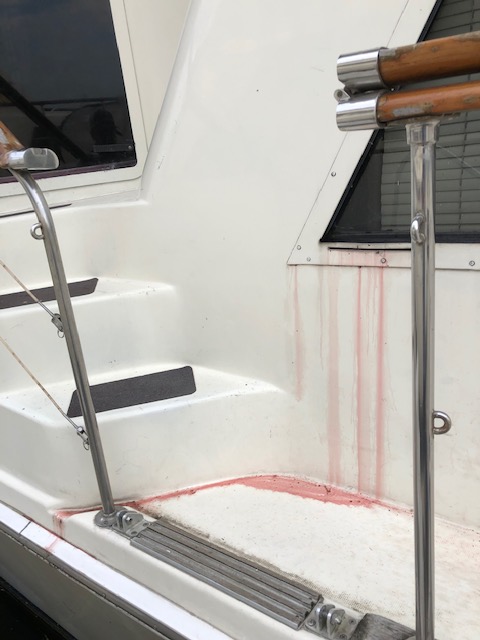
As you can see in the photo above, this is what greeted me the morning after our first purge. Fluid had flowed from the helm station, down the side of the bridge within the bridge lounge/lockers and out the edges of the boat to appear flowing down the side, onto the gunnel. It took quite a while and lots of scrubbing with cleansing soap to get the fluid stains off the sides and the gunnels. But it did come off. Then up to the bridge, opening the settee/lounge/locker to clean up the fluid that had flowed from the helm into the locker space. This took a considerable amount of cleaning rags and elbow grease. Then when the technician returned we set about trying to correct again. Evidently during the evening, the air bubbled back up pushing the fluid out and onto the floor.
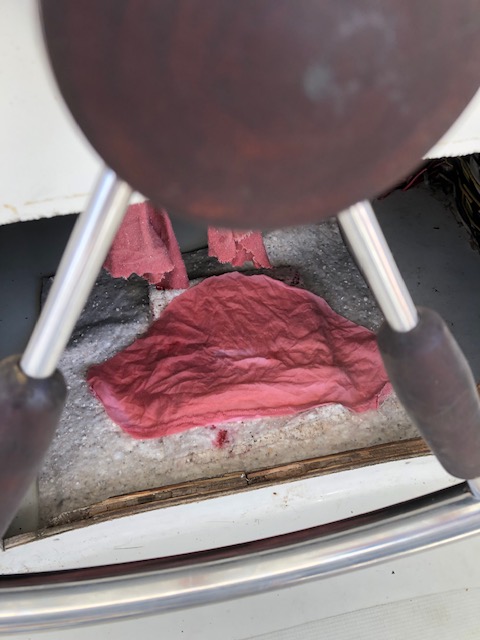
We once again started the adding of fluid into the helm control, testing the helm wheel until restrictions began and we once again got to the point of moving the rudders from hard over to hard over. Again we stopped when this occurred and this time we placed absorbent rags and absorbent pads on the floor beneath the helm control. The photograph below shows what greeted us the next morning.
Another round of bleeding the system to force the air out and we thought we had it again. The photo below greeted me the next morning.
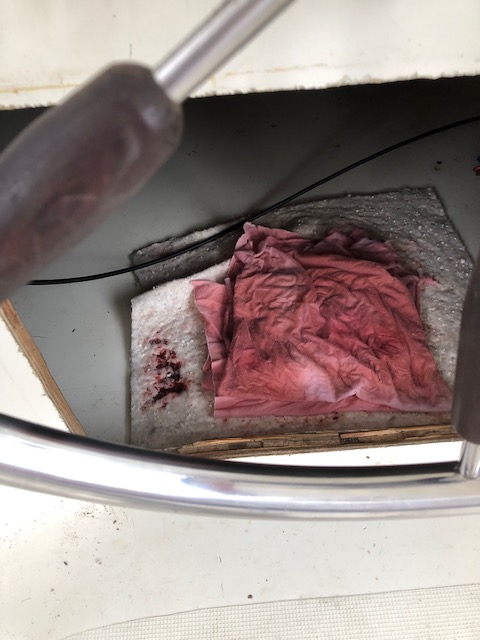
During the next round, (these occurred over a period of several days), we once again found the steering beginning to be responsive, but alas that was not to be the case as seen below.
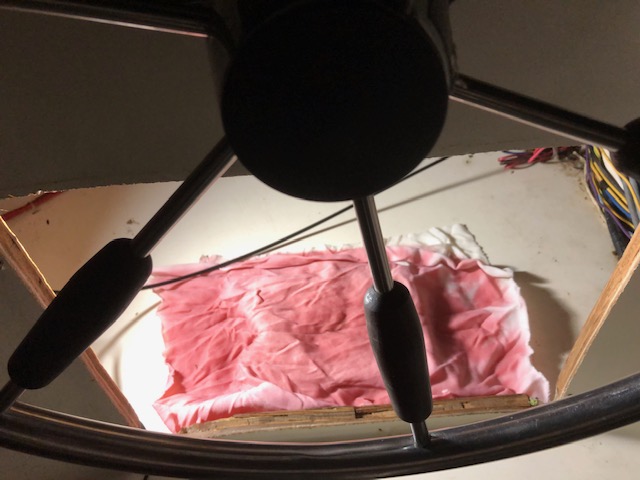
We finally came to the conclusion, after several attempts over many days, to locate any additional leaks and in concert through discussions with the senior technical representative of the pump’s manufacturer, that the pump itself was bad. The options were; remove and ship the pump to the manufacturer and have it rebuilt; purchase a re-manufactured newer technology pump; or purchase a brand new pump of the newer technology. I opted for the re-manufactured pump, but as it turned out parts to build a pump were simply not available, so I wound up buying a brand new pump for just under 1,000 dollars. (boats ain’t cheap folks).
On October 17, we installed the new 1250 pump and proceeded to make the appropriate changes to the system. Turns out the older pump, a 250, required a return line and a distribution valve at the rudder ram. With the capability of the new pump, we were to remove the port and starboard lines from the distribution valve and directly connect them to the lines on the rudder ram and cap off the return line. This removed another point of possible failure for our future boating. One option the manufacturer rep suggested was to pull the entire return line out and discard it. Yeah, like we were going to pull almost 50 feet of hydraulic tubing from the various guides and trace areas; the option to cap the hose was the smartest so that is what we did. Yea us!
After a series of bleeding actions called for in the multi step installation guide, to remove any remaining air, the new pump began to function and steering was returned to the helm wheel and rudders. We validated this by having one person at the helm turning the wheel and a second person in the master cabin with the aft bilge area cover removed so that we could observe the actual movement of the ram and the rudder control arms. When the movement was smooth from port hard over to starboard hard over we then centered the rudder with the observer (me) calling out the position of the rudder indicator. Cell phones do have their uses, to help us communicate from the bridge to the aft master cabin without yelling at each other.
At last, it appeared that we had finally repaired the rudder/helm loss and the old girl was back in business. However the proof of the pudding will be later, when we take her out of the slip, and pilot her down to the confluence of the Anacostia River, Washington Channel and the Potomac. The big hurdle is the winds, we are in the midst of the huge Nor’Easter and unless the winds drop below 15 MPH, we will stay in our slip. The boat is too large, her superstructure is too high and the higher winds will push us all over the place. Our sea trial of the corrective actions for our helm control will occur in the very near future, based on weather, Char’s work availability, and people to assist us in dropping the connections of the old girl, like the docking lines, the power cable, water hoses, and other connections.
If we feel comfortable, we will probably continue on down to past the Wilson Bridge, as long as the weather (high winds) does not interfere. More later, once we have completed the sea trial later this week, if the wind gods will allow, but for now we will wrap this entry about the trials and tribulations of large boat ownership.
Stay Tuned???

 Misty Lady Thought and Comment