
Before I get into the stuff about the seaworthiness test, I thought it might be interesting to tell you about an incident that happened the night/early morning, of November 5th. The Misty Lady uses a combination of AC and DC power to operate our onboard items, such as lights ( both AC and DC lighting), water pressure pumps, etc. Our refrigerator operates on standard AC power but also has a DC subsystem that controls the operational sensors. There is a warning component that informs us that the fridge has lost AC power and this is what Charlotte woke from at 3 am on that November morning. Also our stove top, coffee maker and both TV’s operate on standard AC power. So like most motor yachts we use both types of electrical power. Charlotte woke me up and informed me that our power was off. The boat’s DC units would continue to operate off the installed battery banks but the AC was inoperative which caused our heaters to shut down and the fridge to stop working. We put on some shoes and went to the dock pedestal where our shore power connection is located. Turned out one of our 50 amp cables had become disconnected from the movement of the boat’s bow (winds blowing us back and forth) that put a strain on the cable connection.
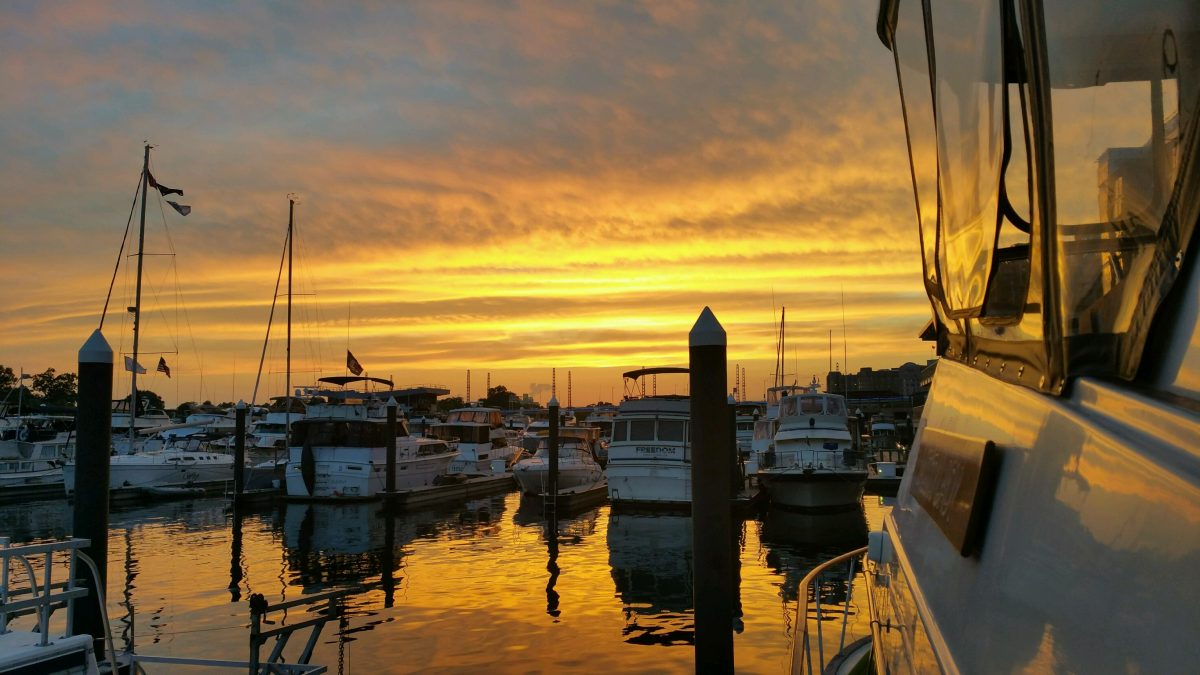
We flipped off the circuit breaker and Charlotte reconnected the cables twist locks to restore our power. We reset the circuit breaker and then tested several AC items to ensure that full power was restored on both our power segments ( our boat has two AC segments, one each running down the port and starboard sides of the interior of our floating home. As we got back into bed, the phrase that most live aboard boaters use came to mind: “Living the Dream” afloat. Sometimes they are nightmares, but those are dreams as well. Things like the power loss are the stuff of the BOATING LIFE. Would we rather be ashore? Take a look at this scene,

This is the sunrise just breaking over the waterfront as we leave the boat to go to the clubhouse early in the morning. We see this kind of view a lot, far more than we ever saw when we lived on land.
Our new helm control is installed and the next step is another test of the installation to ensure that all works as it is supposed to do. The new helm control unit was installed on the 17th of this month and we had finished the install and system bleed by the late afternoon.
The picture below is the old helm control, a 250 V model which had been replaced by the 1250 V with better technology, simplified system construct and easier bleed out for trapped air. This old unit will either be shipped to the distributor/rebuild company, if they want it and are willing to cough a couple of dollars, or we will toss it out.
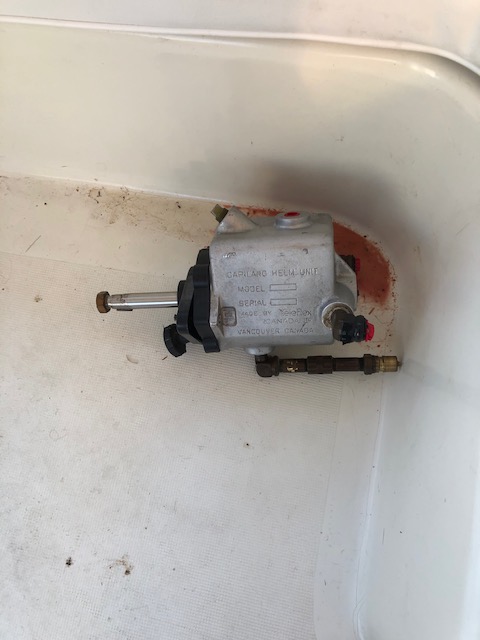
Looks like I have a bit of fluid to clean up on the deck, guess there was still some residual fluid in the pump’s tank.
Our original plan was to combine an actual helm sea trial with the Yacht Club requirement for an annual seaworthiness test. The next day was very bad for boating with winds gusting into the 40-50 mile an hour speeds. Taking a boat out in that weather would be an exercise in utter stupidity. The weekend was no better, with meetings for Char in Virginia taking the morning, up to early afternoon, and other chores to get done, the Saturday plan was blown. Sunday was miserable, temps around 50 degrees, constant rain, and some winds. Winds were infrequent and were not strong at all, but coupled with the temperature and the rain, we decided to bag it for that weekend. The Plan was then to make the trip on Friday of the coming week.
Friday, October 25, 6:45 am: We are now making preparations for the coming seaworthiness certification. Estimated Departure would be around 10:00 am, which is the optimum time for assistance from the Club’s dock stewards to cast off our lines and power connections. We will attempt to leave a bit sooner but only if we find others to assist.
The photo below is of Charlotte in the engine room bilge area, checking the fluid levels in the main engines, the transmissions and the generator, prior to start up to ensure that the proper levels of oil are available. Damage to one of these engines is NOT something we ever want to experience again. She had to add some oil to the port engine, but the starboard was okay. We will be changing the fluids out come spring, according to our plan. Depends on the availability of the diesel specialist.
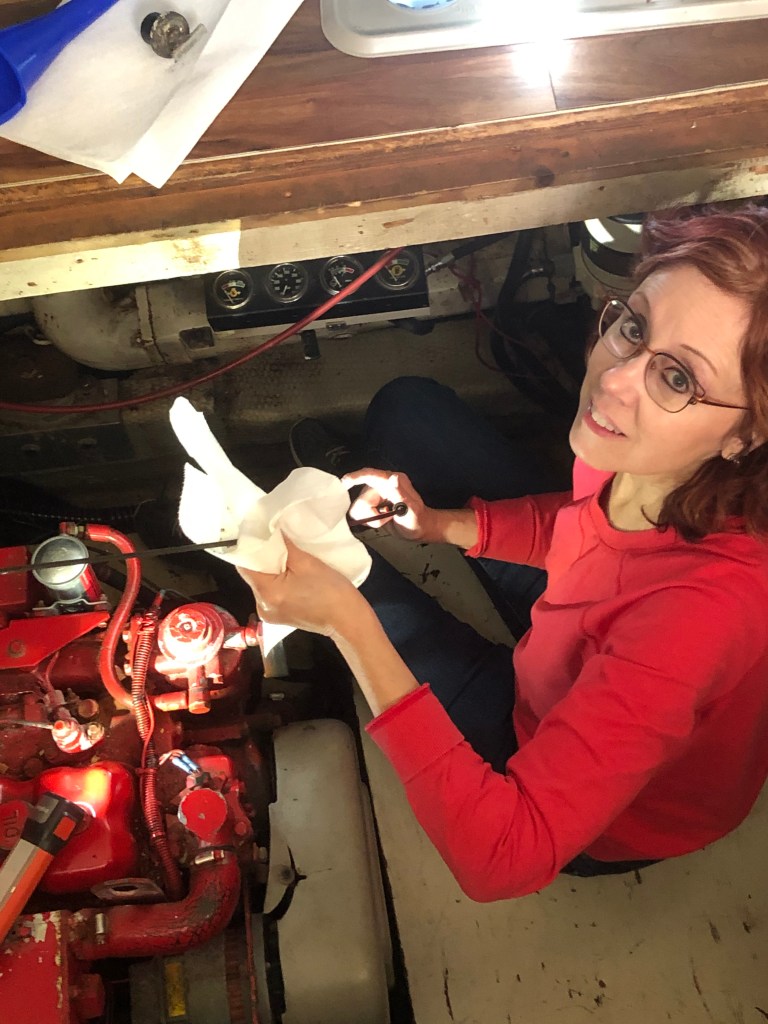
The gauges at her knee are on the port side big Cat Diesel and the red engine is the generator set that provides us with 20KV of electrical power when the boat is disconnected from shore power.
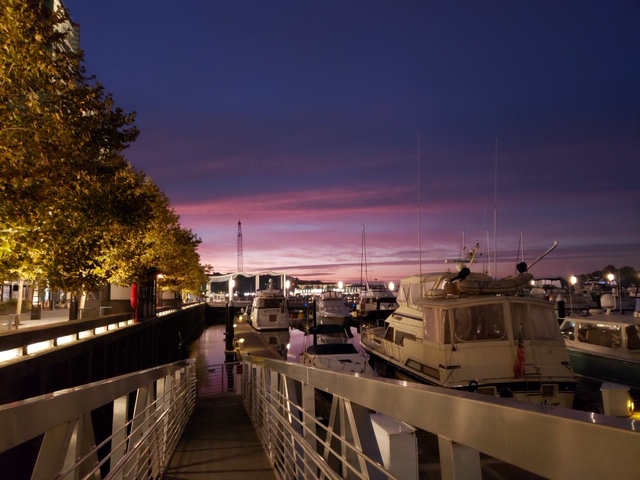
This photo is of our early morning sunrise, just starting to light up the eastern skies. This picture was taken as we were leaving the Clubhouse after our showers (showering here saves water from our on board tank and having to break out the freshwater hose, to refill the 150 gallon tank), walking down the ramp toward the B and A docks.
Current plan was to contact the dock steward to assist in the castoff betweem 10:30 and 11:00am
Actual departure was 12:30 pm as we had the lines cast off, and slowly backed the big girl out into the fairway between A and B docks. Once I got the clear indication from Charlotte that our bow was clear for turning, I began the process of turning the boat using the transmissions and the props to alter our direction turning us onto a heading out of the fairway and into the Washington Channel. You do not use the rudders inside the marina or in any confined areas, because the prop speed has to be a lot higher than safe for these tight areas, to make the rudders functional. So in these areas, the watchword is always, “go slow like a pro” and use only the props and transmission to move about. As we approached the end of the fairway, entering the Washington Channel (WC), we sounded our boat’s horn to inform any other boaters that the big girl was coming out to play.
Entering the channel and turning on a southern heading toward the confluence of the Anacostia River, the WC, and the Potomac, we used the transmissions/screws to navigate down the waterway. Water taxi, other motor yachts, and the Metro Police Marine Patrol boat were our companions afloat going outbound.
About half way down the Channel, I decided to only complete the Annual Seaworthiness Certification and perhaps do an actual sea trial at a later date. We completed the voyage to the Hains Point area, at the confluence of the Anacostia, the Channel, and the Potomac and returned to the Yacht Club marina to our home berth. This completed the Club’s requirement for annual certification of seaworthiness for the Misty Lady. I provided the club management and the club’s flag officers with proof of our voyage and got our name checked off on the listing of seaworthy vessels.
We decided that we would do another static test of the rudder control while in the slip, with Charlotte observing the rudder system, at the master cabin hatch to the aft bilge area and I on the bridge, we would communicate through our cell phones for the test. This test went very well, and the rudders moved as they should in response to the turns I made on the helm wheel.
About the Water Taxi: The water taxi system, connect the City of Alexandria, the D.C. Wharf, Georgetown, and National Harbor for passenger traffic. The price of these water travel boats is pretty darn reasonable, especially if you want to visit DC and don’t want the aggravation of trying to find minimally existent parking. Park in Alexandria, and board the water taxi for your specific destination. Travel to the DC Wharf connects you conveniently with the National Mall/Smithsonian Museums, multiple Metro lines, and two theater venues. There is a free shuttle at the Wharf that will take you to the L’Enfant Metro Stop, the Smithsonian, and the L’Enfant Plaza marketplace where the new Spy museum recently opened. Also at the Wharf you will find the oldest active fish market in the country. These water taxi routes connect with points of interest in the Washington DC Metro area. Many local residents, along with visitors to the area, use these water taxi routes to avoid the horrendous traffic and parking aggravation of the City of Washington, DC. Parking in Alexandria is far less expensive than in the city of Washington.

The photo above shows two of the Potomac Water Taxi boats, docked at the Recreation Pier of the DC Wharf. From there, these boats travel to Alexandria, VA; National Harbor, MD; and Georgetown, DC.
At this writing, we are having the Misty Lady don her winter garb. Which means that any further voyages down river will have to wait until spring. Temps are forecast to drop into the 40’s and down into the 30’s over the coming week and overnight temps could drop into the upper 20’s and lower 30’s. Enough to make the protection of the boat decks and upper structures as well as provide additional insulation for us aboard, make this shrink wrap action almost mandatory. Some folks do not to this, but we have for the three years we have lived aboard this old girl and will continue to do so each winter until Charlotte retires and we say farewell to this area for warmer boating climes.
The local marine specialist has started the process of doing the shrink wrap of our boat, from bow to stern, from the radar arch to the mid hull surface. The following photos show the infrastructure rigging that the specialists have installed on the Lady’s decks. The white tape looking stuff is some very strong ribbon like item.
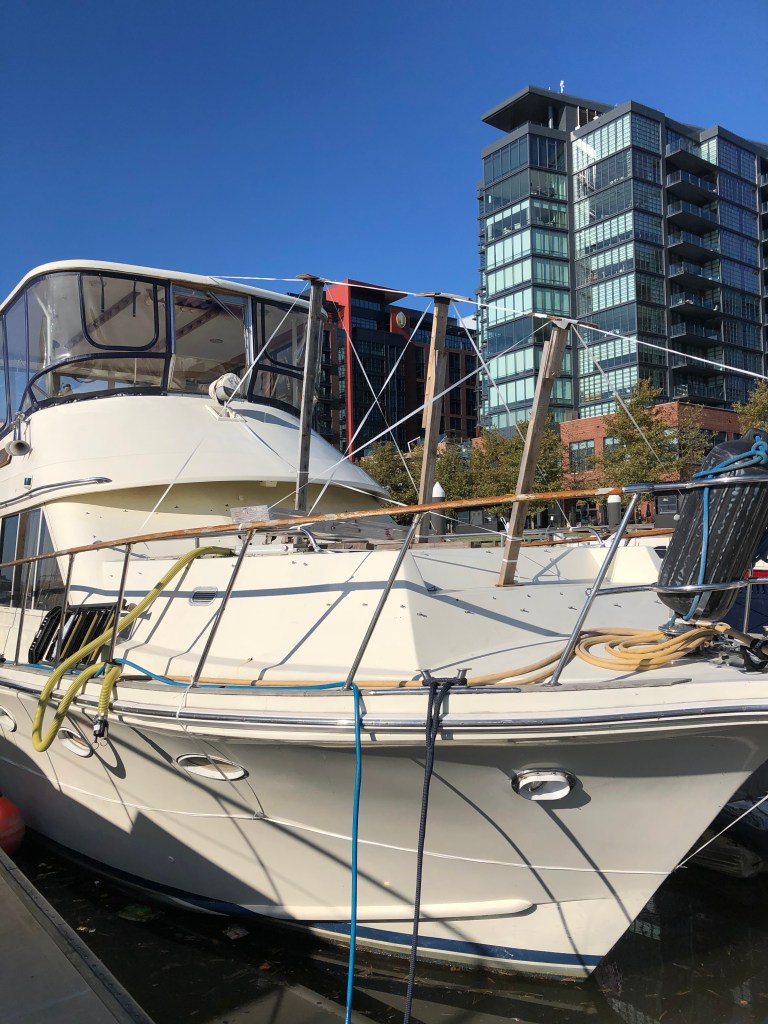
Rigging from the bow sprit, over the bridge roof, the radar arch, and then down to the stern bulkhead.
A longer view of the bow decks and the shrink wrap rigging. You can just make out the line of rigging tape along the hull that will be the anchor for the vinyl covering over our engine room intakes and the port hole windows to keep out the vagaries of our DC winters.

The photo below is showing the starboard side and the framework for a sliding door that will allow us to enter and leave the boat during the winter when the shrink wrap vinyl covers the entire upper section of our boat.
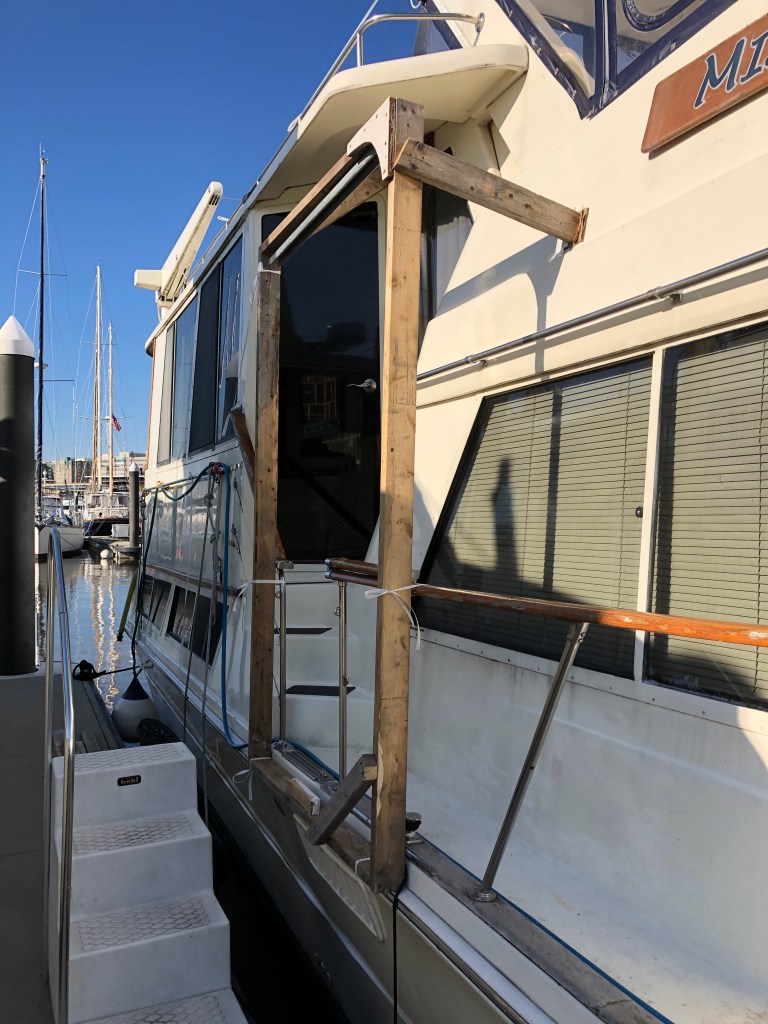
We are expecting that the team of marine specialists will have the entire boat covered in the next day or so. We hope that the final installation of the wrap will beat the forecast that we have for snow in the near future. YIKES.
The shrink wrap sheets will be applied over the next few days, currently the winds are in the 17 to 20 MPH and handling the large sheets of vinyl wrap could be very dangerous.
I had wanted to hold off on publishing this blog entry until they actually got the boat shrink wrap completed but it might be a considerable delay. They are currently working on another boat nearly our size a few slips down from us and we will be the next in line. Might be later today, or even Monday, the 11th. I will take some photographs of the process if possible and then do a short blog entry when it is completed.
Stay Tuned., more to come

 Misty Lady Thought and Comment